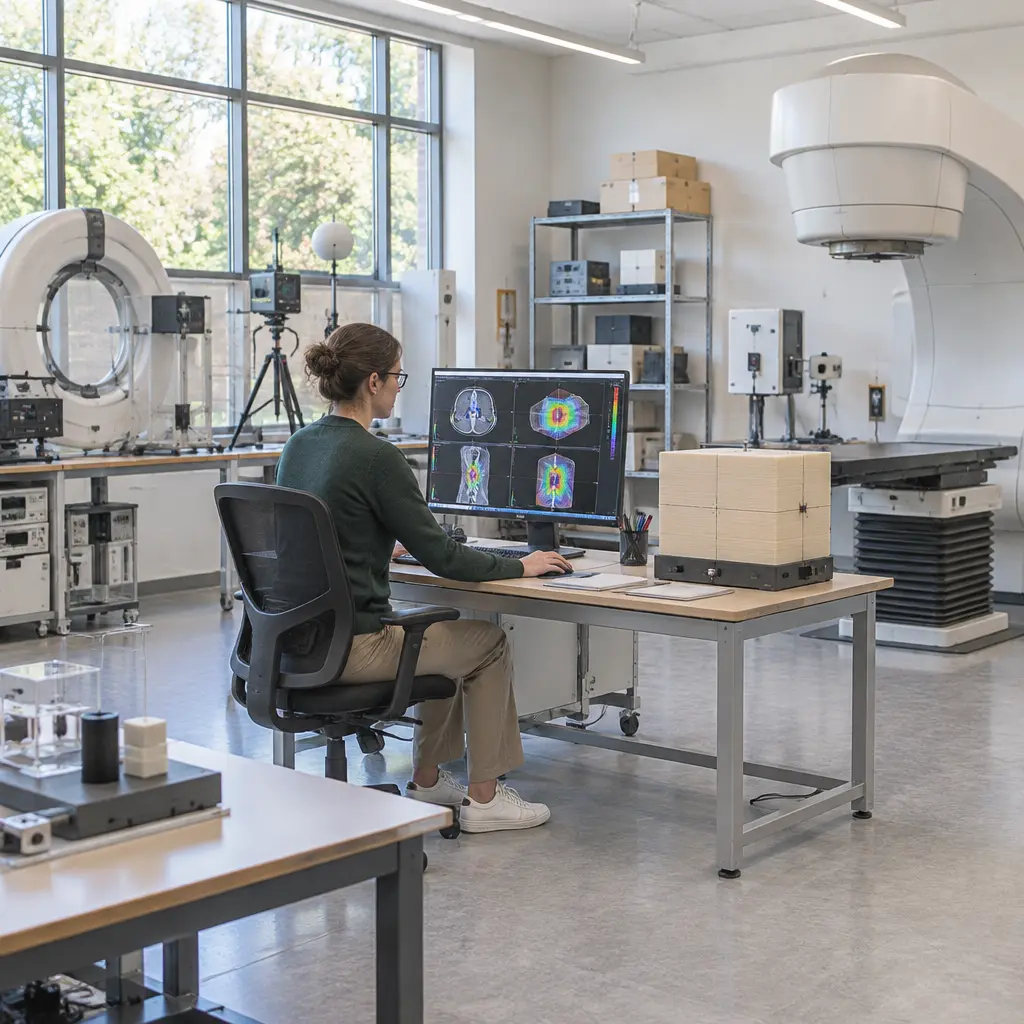
Healthcare workflow integration is the process of fitting a new device into the clinical, technical, and administrative work that care teams already perform. Assessing staff learning curves before procurement means evaluating how quickly and reliably intended users can learn the device and use it within real workflows—not simply whether they can operate it after a demonstration. This assessment matters because the U.S. Food and Drug Administration (FDA) identifies user interface and use-related risks as important considerations in medical-device safety, while the World Health Organization has estimated that around one in ten patients in high-income countries experiences harm in health care. A structured pre-purchase evaluation can reveal training needs, workflow disruptions, safety risks, and support costs early enough to compare products on more than purchase price.
Healthcare workflow integration and staff learning curves
A staff learning curve describes the change in a user’s performance as experience with a task or device increases. In procurement, the relevant question is not only how fast staff become proficient, but also how learning affects accuracy, workload, coordination, and patient care. The concept is best treated as an evaluation framework rather than a single standardized metric: device complexity, user experience, training design, clinical setting, and the workflow into which the device is introduced all influence results.
The FDA’s human-factors guidance describes human-factors engineering as the application of knowledge about people’s abilities, limitations, and other characteristics to the design of devices and systems. Applied before procurement, this perspective shifts the evaluation from “Can a person operate the device?” to “Can the intended users operate it safely and effectively in the conditions in which it will actually be used?”
Learning-curve measures: time, errors, and retention
A practical learning curve tracks performance over repeated, representative tasks. Useful measures include time to complete a task, successful task completion, use errors, requests for assistance, adherence to critical steps, and performance after a delay without practice. A single average can hide important differences: one task may become faster while a safety-critical step remains error-prone.
The Institute of Medicine’s report To Err Is Human estimated that between 44,000 and 98,000 people died annually in U.S. hospitals from preventable medical errors, based on studies available at the time. Those historical estimates are not a measure of device-related harm or current incidence, but they underscore why procurement evaluations should record errors and near misses as well as speed. Learning should be judged against predefined safety and proficiency criteria, not assumed from attendance at training.
Workflow fit as a distinct procurement attribute
Workflow fit is the degree to which a device’s tasks, information exchanges, and physical demands align with how care is delivered. A device can be usable in isolation yet create extra documentation, duplicate data entry, delays, handoff ambiguity, or interruptions when placed in a clinical process. Evaluation should therefore include the full sequence—from preparation and patient identification to use, documentation, cleaning, charging, and escalation of problems.
The Agency for Healthcare Research and Quality’s workflow-analysis resources emphasize examining work as it is performed, including people, tasks, technology, and the surrounding environment. This makes observation and mapping valuable complements to vendor demonstrations. A contextual bridge follows: once the learning curve and workflow fit are defined, procurement teams can test the specific conditions that shape learning and safe adoption.
Assessing device learning curves before procurement
Pre-procurement assessment is a structured comparison of candidate devices using intended users, realistic tasks, and explicit performance criteria. It should include clinical staff who will use the device, staff who support it, and representatives of affected workflows. The aim is to estimate the effort and risk of adoption before a purchasing decision makes switching costly.
Representative users and realistic scenarios
Representative-user testing includes variation in role, experience, shift, and familiarity with related technology. Scenarios should reflect routine use as well as foreseeable difficult conditions, such as time pressure, interruptions, low light, personal protective equipment, alarm handling, or recovery from a failed connection. A small group of expert “super-users” alone may make a device appear easier to learn than it will be for the broader workforce.
The FDA’s guidance on applying human-factors and usability engineering to medical devices recommends identifying users, use environments, and use scenarios, then evaluating whether users can perform tasks safely. Procurement teams can adapt that logic into comparative simulations, ensuring that each candidate is tested on equivalent tasks and under comparable conditions.
Proficiency thresholds and the learning curve
A proficiency threshold is a prespecified level of performance required before a user is considered ready for independent use. It may combine successful completion of critical tasks, acceptable error rates, correct response to alarms, and time limits where timing affects care. The threshold should be clinically justified; a speed target should never reward shortcuts that compromise safety.
To compare learning, record baseline performance, performance after standardized instruction, practice across multiple attempts, and retention after a suitable interval. Report the distribution of results by role or experience, not only an overall mean. Where sample sizes are small, describe uncertainty and treat findings as decision-support evidence rather than definitive proof of performance across an entire workforce.
Training burden and ongoing competency
Training burden includes the time and resources required for initial instruction, supervised practice, competency checks, refresher training, and onboarding of new staff. A complete estimate should account for learner time, educator time, backfill or overtime, training materials, device availability, and the opportunity cost of taking staff away from care. Training burden is different from purchase price and can materially affect total cost of ownership.
The Centers for Medicare & Medicaid Services’ Emergency Preparedness Rule requires covered providers and suppliers to maintain training and testing programs for emergency preparedness, illustrating the broader operational importance of maintaining staff readiness. It is not a device-specific training requirement, but it reinforces that competency and refreshers are ongoing organizational responsibilities rather than one-time launch activities.
Integrating usability, safety, and health information technology
Learning assessment is strongest when it considers the device as part of a sociotechnical system: people, tasks, technology, organizational policies, and the physical environment interact. A device may be easy to learn but difficult to maintain, or clinically useful but poorly integrated with electronic health records, alarms, or handoffs. These related dimensions should be evaluated together before procurement.
Human factors and use-related risk
Human-factors assessment examines how interface design, labels, controls, feedback, and environment affect user performance. It helps identify use errors that arise not simply from a lack of knowledge, but from confusing design, poor visibility, ambiguous feedback, or mismatches between the device and the user’s task. Testing should include high-risk tasks and plausible recovery actions, not just successful routine operation.
The FDA’s human-factors guidance advises manufacturers to use a risk-based process and to validate device interfaces with intended users and use environments. Health systems can use the same principles to scrutinize candidate devices and request evidence on training, usability testing, known use-related hazards, and changes between product versions.
Interoperability and documentation workflow
Interoperability is the ability of systems to exchange and use information. For a connected device, assessment should include data accuracy, identity matching, interface reliability, documentation effort, downtime behavior, and the steps required when information fails to transfer. Staff may need to learn not only the device but also how its outputs appear in the electronic health record and how to verify them.
The Office of the National Coordinator for Health Information Technology has described interoperability as supporting secure access, exchange, and use of electronic health information. In practical procurement, teams should test the actual technical configuration and workflow rather than assume that a product’s stated connectivity guarantees a seamless clinical process.
Accessibility, workload, and equity
Accessibility and equity mean evaluating whether staff with different abilities, language needs, digital experience, and physical characteristics can use and learn the device. Workload assessment also considers cognitive demands, alarm burden, interruptions, and competing tasks. A device that shifts work to a particular role or makes use difficult for some staff may create adoption and safety problems that an aggregate score conceals.
The National Institute for Occupational Safety and Health’s work on healthcare worker fatigue and safe patient handling reflects the wider importance of designing systems around human capabilities and working conditions. Procurement teams can translate that principle into practical questions: Can controls be used while wearing gloves? Is information legible in the actual environment? Does the device add steps during already busy periods?
A practical pre-procurement evaluation protocol
A common protocol makes candidate comparisons more reliable and helps decision-makers trace a purchase recommendation to observed evidence. The following sequence can be adapted to the clinical risk and complexity of the device.
-
Define the clinical need, intended users, use environments, affected workflows, and critical safety tasks.
-
Map current work and identify likely changes, including documentation, handoffs, cleaning, maintenance, and downtime processes.
-
Set measurable criteria before testing: critical-task completion, use errors, time where clinically relevant, help requests, retention, and training hours.
-
Recruit representative users and provide equivalent, standardized introductions to each candidate device.
-
Run realistic simulations or limited pilots, observing task performance and collecting staff feedback without allowing vendor coaching to distort comparisons.
-
Estimate total adoption cost, including training, support, integration, consumables, maintenance, and productivity effects.
-
Document risks, mitigations, unresolved questions, and post-implementation measures as part of the procurement decision.
A useful comparison chart can show each candidate’s proficiency across practice attempts, with separate lines for task completion, critical errors, and time. A companion table can summarize training hours, integration issues, user confidence, and support requirements. Separating these measures avoids reducing a multidimensional adoption decision to a single score.
Real-world lessons and implementation implications
Healthcare technology implementation experience shows why workflow and learning need to be assessed together. Electronic health record rollouts, for example, can change documentation patterns, communication, and workload across professional groups. The Office of the National Coordinator for Health Information Technology’s SAFER Guides provide practices for safer health IT implementation and use, including attention to system configuration, training, and organizational processes.
The transferable lesson is that a successful demonstration does not establish successful adoption. A device may perform well in a controlled room but encounter different staffing, network, space, or patient conditions in routine care. A staged evaluation—simulation, limited pilot, then monitored expansion—allows organizations to detect issues before they affect every unit. For high-risk equipment, clinical engineering, infection prevention, information technology, frontline users, and patient-safety teams should contribute to the review.
After purchase, organizations should continue measuring adoption rather than treating procurement as the endpoint. Useful indicators include competency completion, critical-task errors, service calls, workarounds, downtime, documentation delays, and staff-reported workload. These data can show whether the expected learning curve was achieved and whether additional training, configuration changes, or workflow redesign is needed.
Conclusion: make staff learning a procurement criterion
Healthcare workflow integration and staff learning curves are connected procurement attributes: one describes how a device fits into care, and the other describes how users develop reliable performance with it. Human-factors testing, realistic workflow scenarios, explicit proficiency thresholds, interoperability checks, and full training-cost estimates help organizations compare devices on safety and adoption as well as features and price.
Before the next purchase, assemble a multidisciplinary evaluation team, define critical tasks and acceptable performance in advance, and test candidate devices with representative staff. Use the findings to shape procurement terms, training plans, integration work, and post-launch monitoring. This approach can make adoption more predictable and help ensure that technology supports both clinicians and patients.
Sources: U.S. Food and Drug Administration, Applying Human Factors and Usability Engineering to Medical Devices, https://www.fda.gov/regulatory-information/search-fda-guidance-documents/applying-human-factors-and-usability-engineering-medical-devices; World Health Organization, Patient Safety, https://www.who.int/news-room/fact-sheets/detail/patient-safety; Institute of Medicine, To Err Is Human: Building a Safer Health System, https://nap.nationalacademies.org/catalog/9728/to-err-is-human-building-a-safer-health-system; Agency for Healthcare Research and Quality, Workflow Assessment for Health IT Toolkit, https://healthit.ahrq.gov/health-it-tools-and-resources/workflow-assessment-health-it-toolkit; Centers for Medicare & Medicaid Services, Emergency Preparedness Rule, https://www.cms.gov/medicare/health-safety-standards/quality-safety-oversight-emergency-preparedness; Office of the National Coordinator for Health Information Technology, Interoperability, https://www.healthit.gov/topic/interoperability; National Institute for Occupational Safety and Health, Healthcare Workers, https://www.cdc.gov/niosh/healthcare/; Office of the National Coordinator for Health Information Technology, SAFER Guides, https://www.healthit.gov/topic/safety/safer-guides.