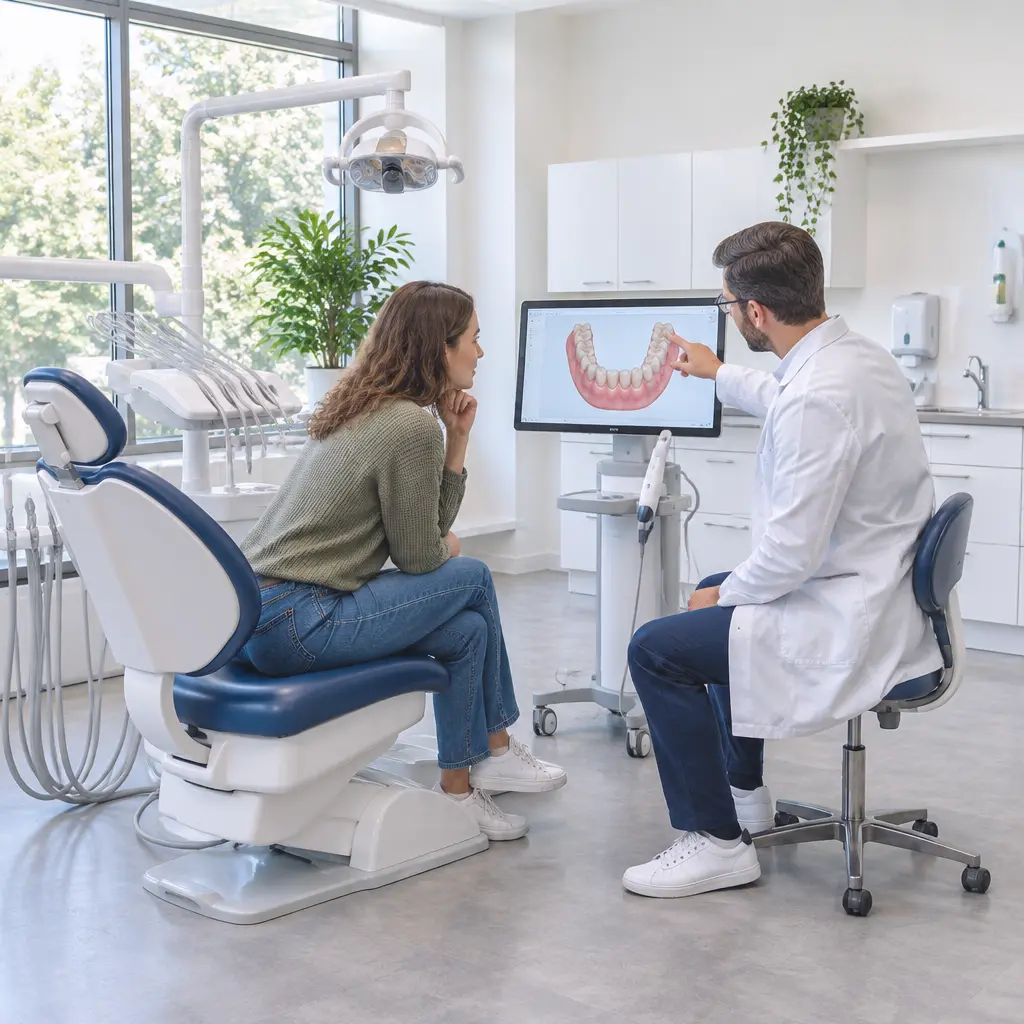
Dental technology includes the devices, materials, software, and procedures clinicians use to diagnose and treat oral disease. It can raise the price of a particular visit when it adds equipment, laboratory work, or staff time, but it does not automatically make dental care more expensive overall: technologies such as digital imaging, computer-aided design, and guided treatment may reduce repeat appointments, remakes, or complications. Available evidence is mixed because prices depend not only on technology but also on the procedure, practice costs, insurance, and local market. The distinction matters as U.S. dental spending reached about $165 billion in 2022, according to the Centers for Medicare & Medicaid Services. This article examines how treatment prices are measured, which technologies add or may save costs, and what patients can ask before choosing a technology-assisted treatment.
How dental technology affects treatment cost
Dental technology’s cost effect is the change in a patient’s or health system’s total expense attributable to using a tool or technique rather than a relevant alternative. Health economists distinguish the purchase and operating cost of a technology from its cost-effectiveness: whether the additional expense produces enough improvement in health, function, or time saved to justify it. The National Institute for Health and Care Excellence (NICE) uses a similar principle in health-technology assessment, comparing costs with outcomes rather than treating a higher price as proof of better value.
For dental care, the comparison should include more than the equipment price. It may include clinician and staff time, maintenance, training, materials, laboratory fees, follow-up visits, repairs, and the cost of managing complications. A technology can therefore make one procedure more expensive while lowering the cost of the full course of care—or add expense without a meaningful improvement.
Direct costs: equipment, materials, and laboratory work
Direct costs are resources used to deliver treatment. A practice investing in a dental scanner, milling unit, 3D printer, or cone-beam computed tomography (CBCT) system has to account for purchase or financing, software, maintenance, training, and supplies. The cost per patient depends partly on how frequently the system is used: a heavily used scanner spreads its fixed costs across more cases than one used occasionally.
Technology may also shift rather than eliminate costs. A chairside restoration system can reduce reliance on an external laboratory for some cases, but it requires in-office equipment, materials, and staff expertise. Conversely, a digitally designed restoration may still require outside production and associated laboratory fees. The American Dental Association’s Health Policy Institute tracks dental spending and practice economics, but national expenditure figures alone cannot establish what technology contributed to an individual procedure’s fee.
Total treatment cost and value
Total treatment cost includes the initial procedure and relevant later care, such as adjustments, replacement, additional imaging, or treatment of a complication. Cost-effectiveness asks whether the clinical gains are worth the difference in total cost. For example, a more expensive restoration could represent better value if it lasts longer or avoids repeat treatment—but that conclusion requires reliable evidence about outcomes and long-term costs, not just a claim that the technology is newer.
This broader definition connects price to clinical need. A technology’s value depends on the patient, the diagnosis, the operator’s experience, and the available alternatives. With that framework in mind, the next question is which technologies tend to add cost and which may offset it.
Which dental technologies add cost—and which may offset it?
Dental technologies vary widely, so their financial effects should not be treated as interchangeable. Diagnostic imaging, digital impressions, CAD/CAM restorations, and implant-planning tools affect different stages of care. Research reviews, including assessments published in the Journal of Dentistry and other clinical journals, often find that digital workflows can improve convenience or precision in particular situations, while evidence on overall costs and long-term outcomes is less consistent.
Digital imaging and cone-beam CT
Digital radiography uses electronic sensors to capture dental X-ray images, while CBCT creates a three-dimensional view of structures in the head and jaw. Digital systems can make images available quickly and simplify storage and sharing. CBCT can supply additional anatomical detail for selected cases, such as complex implant planning or impacted teeth, but it involves more radiation than many routine dental X-rays and is not necessary for every patient.
The U.S. Food and Drug Administration advises that dental CBCT should be used only when clinically necessary and when the expected benefit outweighs radiation risk. Because an advanced scan may carry an additional charge, patients can ask what question it is intended to answer, whether a lower-dose or two-dimensional image would suffice, and how the result could change treatment. More imaging is not automatically better or more cost-effective.
Intraoral scanners and digital impressions
An intraoral scanner captures a digital model of the teeth and gums, often replacing a conventional impression tray for crowns, aligners, and other appliances. Scanning may be more comfortable for some patients and can allow a clinician to inspect or transmit a model quickly. Yet the device, software subscriptions, training, and occasional need to correct or repeat a scan contribute to practice costs.
Whether scanning reduces total cost depends on the workflow and treatment. A digital impression may shorten steps or avoid shipping a physical mold, but it does not guarantee fewer appointments or a lower restoration fee. The relevant comparison is the complete process—including any laboratory charges, adjustments, and remakes—rather than the impression method alone.
CAD/CAM crowns and chairside milling
Computer-aided design and computer-aided manufacturing (CAD/CAM) use digital models and milling or printing systems to create dental restorations. In a chairside workflow, some crowns can be designed and made within the dental office, potentially allowing treatment in fewer visits. However, the equipment and materials require investment, and the clinical suitability of a same-day restoration depends on the tooth, bite, material, and clinician’s judgment.
A shorter process may save a patient travel time or temporary-restoration appointments, but that does not establish that the treatment is cheaper. Published comparisons of digital and conventional workflows report results that vary by restoration type, practice setup, and study assumptions. Patients should compare the quoted total fee and ask whether the proposed material and workflow are appropriate for their case.
Implant planning, robotics, and 3D printing
Digital implant planning can combine scans and three-dimensional models to help plan implant position; guides or navigational systems may assist placement. Three-dimensional printing can produce surgical guides, models, or appliances. These tools may be useful in complex cases, but they add planning, equipment, production, and training costs. The American Academy of Implant Dentistry and other professional bodies emphasize appropriate case selection and clinician competence; technology does not replace diagnosis or surgical judgment.
For a patient, the key issue is whether the added planning is relevant to the clinical situation and whether it changes expected outcomes. Ask whether the technology is essential, optional, or simply the practice’s preferred workflow, and request an explanation of any separate fee.
What the data can—and cannot—show about dental prices
National spending data describe the scale of dental care, not the price effect of a specific device. CMS National Health Expenditure data put U.S. dental services spending at approximately $165 billion in 2022, around 3.7% of total national health expenditures. The Bureau of Economic Analysis and CMS track aggregate spending, while the Bureau of Labor Statistics’ Consumer Price Index measures changes in consumer prices for categories including dental services. None of these measures isolates how much of a fee increase is caused by technology.
Likewise, a fee comparison between two practices does not by itself prove that a digital tool caused the difference. Practices may differ in geography, staffing, laboratory arrangements, materials, overhead, insurance participation, and the complexity of patients’ needs. A sound comparison specifies the same procedure, tooth or treatment area, materials, included services, and follow-up assumptions.
Why evidence on savings is mixed
Studies may count different costs and outcomes. One may include only chair time; another may add equipment depreciation, training, and laboratory expenses. Some studies evaluate accuracy or patient comfort rather than total cost, and relatively short follow-up may miss later repair or replacement. As a result, evidence that a digital method is faster or more precise is not automatically evidence that it reduces lifetime spending.
Technology also changes over time. A system’s purchase cost, software, and workflow can differ substantially from one practice to another, and early adoption may be more expensive than mature, high-volume use. The most useful evidence is therefore procedure-specific, transparent about its assumptions, and based on both clinical outcomes and the full treatment pathway.
Insurance coverage and out-of-pocket costs
The amount a patient pays is not always the same as the provider’s charge or the full cost of care. Dental insurance plans commonly use annual maximums, coinsurance, deductibles, and coverage rules that vary by contract. A technology-related service may be bundled into a procedure, billed separately, or treated differently by a particular plan. Coverage should be confirmed with the insurer and practice rather than assumed from the technology’s name.
Before treatment, patients can request a written estimate that separates the procedure, imaging, materials, laboratory work, and optional services where applicable. They can also ask whether a less costly clinically appropriate alternative exists and whether the quoted amount reflects the insurer’s estimate or the practice’s standard fee.
How patients can judge whether a technology is worth the price
A technology is worth considering when it addresses a defined clinical need and its expected benefits are proportionate to its risks and costs. Patients do not need to evaluate the equipment themselves, but they can ask focused questions that connect the proposed tool to diagnosis, treatment choices, and the total financial commitment.
- What clinical question will this scan, scanner, or device answer?
- How would the result change my treatment plan?
- Is there a clinically suitable alternative, and how do its benefits, risks, visits, and price compare?
- Does the quoted fee include imaging, laboratory work, materials, adjustments, and follow-up?
- Is the technology optional, and will my dental plan cover any part of the charge?
- What evidence supports the expected benefit for my specific procedure?
For example, a three-dimensional scan may be justified when a clinician needs anatomical detail for a complex procedure, but may add little value for a routine situation that can be assessed adequately with standard examination and imaging. Similarly, chairside milling may reduce visits for a suitable crown case, yet another patient may benefit more from a different material or laboratory workflow. The decision should be individualized, not based solely on claims such as “faster,” “digital,” or “same-day.”
Conclusion: technology can raise fees, but value depends on the whole treatment
Dental technology can increase the price of a visit through equipment, training, materials, and added diagnostics. It can also potentially reduce laboratory steps, repeat visits, or avoidable errors in selected circumstances. The available national spending and inflation statistics show that dental care is a substantial household and health-system expense, but they do not prove that technology alone is driving treatment prices. Evidence must be considered procedure by procedure and across the full course of care.
Patients can make more informed decisions by asking what the technology changes, what the total fee includes, and whether a clinically appropriate alternative is available. For further guidance, consult a licensed dentist, request a written treatment estimate, and verify coverage with the dental plan before authorizing optional services.
Sources: Centers for Medicare & Medicaid Services, National Health Expenditure Data, https://www.cms.gov/data-research/statistics-trends-and-reports/national-health-expenditure-data; American Dental Association, Health Policy Institute, https://www.ada.org/resources/research/health-policy-institute; U.S. Food and Drug Administration, Dental Cone-beam Computed Tomography, https://www.fda.gov/radiation-emitting-products/medical-x-ray-imaging/dental-cone-beam-computed-tomography; U.S. Bureau of Labor Statistics, Consumer Price Index, https://www.bls.gov/cpi/; National Institute for Health and Care Excellence, Health Technology Evaluations: The Manual, https://www.nice.org.uk/process/pmg36; Joda, T., Zarone, F., and Ferrari, M., “The complete digital workflow in fixed prosthodontics: a systematic review,” Journal of Dentistry, 2017, https://doi.org/10.1016/j.jdent.2017.07.022; U.S. Centers for Disease Control and Prevention, Oral Health Surveillance and Resources, https://www.cdc.gov/oral-health/